How to Write a Romantasy Novel: The Complete Guide

What I have learned so far about writing romantasy, 65,000 words into a first draft, and the resources that taught me.
To write romantasy, you build two stories at once, a fantasy plot and a love story, and you make each one impossible to resolve without the other. Start with what your main character wrongly believes about herself, braid the romance beats into the external plot so the turning points land together, and let the world itself keep your leads apart.
That is the short version. A caveat before the long one: I am calling this a complete guide while in draft one of my own debut, a dystopian romantasy, at 65,375 of a planned 120,000 words (and I have probably already written two books of world-building alone). I am not published and I have no agent stories, so read this as notes from someone still in the middle of it.
What romantasy is, and the promise it makes
Romantasy is fantasy in which the love story is load-bearing. Take the romance out and the book falls down. Take the magic, the politics and the danger out and it falls down just as fast.
That matters because each half comes with a promise to the reader.
The romance half borrows its promise from the romance genre. The Romance Writers of America defines a romance by two things: a central love story, and an ending that is emotionally satisfying and optimistic. Romantasy readers will often wait several books for that ending, and they will forgive you a great deal of ruin on the way. They will not forgive a love story that turns out to have been decoration.
The fantasy half promises a world with rules and a problem bigger than two people.
So before you write a word, it helps to know which promise leads in your book. If the romance leads, the fantasy plot exists to pressure the couple. If the fantasy leads, the romance is a strong subplot that changes how the main plot ends. I wrote about the second kind in how to master romance as a subplot in fantasy novels. Either is fine. But you do have to choose, because the choice decides where your turning points go.
Dustling isn’t out yet, but you can read Chapter One free.
Start with the wound, not the plot
A draft that feels thin, with a lot happening and not enough weight, is often a character problem and not a plot one. The book that makes this case is Story Genius by Lisa Cron. Cron's argument, roughly, is that plot is what happens on the surface and story is what happens inside the protagonist. The external problem exists to force an internal change. She calls that internal struggle the third rail, the thing that gives everything else its charge.
The useful distinction is between two things that are easy to blur. There is the wound, the thing that happened to your character. And there is the misbelief, the false conclusion she drew from it and has been living by ever since. Knowing a character's history in detail is not the same as knowing the specific lie it taught her.
In romantasy this is doubly useful, because the misbelief is usually the real reason she cannot be with the love interest. The curse, the war and the opposing sides are the visible obstacles. The belief underneath is the true one.
Wound: My mother left and my brother died
Belief: I don’t deserve love / People always leave so there’s no point getting to know them
Practical version, for a first pass:
What happened to her? One event, specific, before page one.
What did she decide it meant? One sentence, written as she would say it.
How does that belief protect her? It has to have worked, or she would have dropped it.
What will the plot cost her if she keeps it? This is your climax in miniature.
Do the same for the love interest. His misbelief should grate against hers.
I wrote the longer version in what Story Genius taught me about my heroine's wound. If your draft feels hollow and you keep fixing the plot, read that one first.
Two plots, braided
This is the part most people mean when they search for romantasy plot structure.
You have an external plot: the trials, the rebellion, the curse, the throne. You have a romance arc: two people moving from distance to trust to love. Written separately and shuffled together, they give you a book that alternates, and the reader can feel the seam.
Braided, each turning point does two jobs. The same event that changes the external situation also changes what the leads are to each other.
How to balance romance and fantasy plot
The balance question is really a question about where the big moments land. The structure I use here is a Save the Cat-inspired beat sheet.
It comes from Blake Snyder's screenwriting book Save the Cat! (2005) and was adapted for novelists by Jessica Brody in Save the Cat! Writes a Novel (2018). It has fifteen beats, from Opening Image to Final Image. For braiding, five of them do most of the work:
External beat | What the fantasy plot does | What the romance should be doing |
|---|---|---|
Catalyst | The world breaks its routine and pulls her in | The leads are put in each other's path, usually against their will |
Break Into Two | She commits to the new situation | They are now stuck with each other, and neither can simply leave |
Midpoint | A false victory or false defeat; the stakes rise | The relationship changes category: a truth told, a line crossed, an alliance made |
All Is Lost | The plan fails and something is taken | The misbeliefs win; they break, betray or retreat |
Finale | She solves the external problem as a changed person | The change that saves the world is the same change that lets her love |
The Midpoint sits at roughly halfway and All Is Lost at roughly three-quarters. Those are the two places to check first. If the plot's midpoint twist and the romance's midpoint shift are forty pages apart, the middle sags twice.
A test worth running on any outline: describe a turning point without mentioning the love interest. Then describe it without mentioning the external plot. If either version still makes complete sense, the two strands have not met there yet.
My full version, with where the love story should be at each of the fifteen beats, is in the Save the Cat-inspired beat sheet with romance subplot progression.
If you hate plotting
I find that being able to pants my way through a plotted outline is the best thing for me. I like to leave things open and only write down exactly why I need the scene I’m working on: is the goal clear for the POV character? If so; then I’ll start pantsing until the scene is done.
If a fifteen-beat grid is too much, start smaller. In how to plot a dystopian romantasy novel for writers who hate plotting I walk through a looser method: characters first, then the world, then the five to ten scenes you cannot wait to write, connected by a loose three-act frame. For the wider process there is also my step-by-step guide to crafting fantasy.
Romance beats in brief
The resource romance writers most often point to is Romancing the Beat by Gwen Hayes, a short structure guide written specifically for love stories. It divides the arc into four phases: the setup, falling in love, retreating from love, and fighting for love.
Stripped right down, the movement looks like this:
Meeting. They collide, and each has a good reason to say no.
Adhesion. Something outside them forces them to stay close. In romantasy, the plot does this for you: a trial, a bargain, a bond, a shared enemy.
Resistance wearing thin. Small proofs that the other person is more than expected. Desire arrives before trust does.
A midpoint that feels like arrival. They let each other in. It is too early, and both misbeliefs are still intact.
Doubt and retreat. The old fears reassert themselves. Shields go back up.
The break. The worst thing each believes about love appears to be confirmed.
The dark night. Each sees what the belief has cost.
The choice. One or both act against the misbelief, at real risk.
Wholehearted. They are together as changed people.
Lay that list beside the table above and you can see why the two structures braid so readily. Both have a midpoint that looks like winning. Both collapse at around three-quarters. Your job is to make each pair of beats one event instead of two.
In a series, the arc stretches. Book one might end at beat four or beat six, with the rest held back. That is fine, as long as book one closes its own external plot and leaves the reader certain the love story is going somewhere.
Worldbuilding that serves the romance
Fantasy writers are warned about worldbuilding for its own sake. Romantasy gives you a simple filter: does this piece of the world make the love story harder?
The strongest romantasy worlds forbid the romance. The obstacle between the leads is built into the magic system or the social order, so that loving each other means breaking something that everyone else depends on.
Some useful questions:
Who holds power here, and what does it cost the people who do not? A hierarchy puts your leads on different rungs before they have met.
What does magic cost, and who pays? A cost that falls on one lead when the other uses power is a romance obstacle and a plot engine in one.
What is forbidden, and who enforces it? Laws, castes, vows, bloodlines. A rule with an enforcer gives the couple something to hide from.
What would have to change in the world for these two to be together openly? If the answer is "nothing", the world is scenery.
When the answer to that last question is big, the love story and the fantasy plot share a climax by design, because the couple cannot have their ending until the world shifts.
Pick your tropes on purpose
Tropes are promises in shorthand. A reader who picks up a book for forced proximity or hidden identity knows what she came for and will notice if it does not arrive. So choose a few, and choose them because they come out of your characters and your world.
My own draft, Dustling, carries slow burn, enemies to lovers, forbidden love, forced proximity, hidden powers, found family and deadly trials, so I am in no position to tell anyone to pick fewer. A stack like that holds up when each trope has a source: forbidden love from the world's rules, forced proximity from the plot, slow burn from the misbeliefs. If you cannot say where a trope comes from, it is probably there for the marketing graphic.
Writing enemies to lovers
I wrote a whole essay on this one: the counterfeit enemy. The argument is that most of what gets shelved as enemies to lovers is friction: sharp words, a cold shoulder, two people who annoy each other at a party.
Real enmity is structural. The two leads stand for things that cannot both be right. That is harder to write and far more satisfying to resolve, because the reconciliation has to cost something.
If you are writing enemies to lovers, ask what each lead would have to give up to stop being an enemy. If the answer is "being rude", you have rivals, which is a perfectly good trope under its own name.
For how the major tropes work and what readers expect from each, my romantasy tropes guide goes through them one at a time.
Pacing a slow burn
A slow burn is slow for the characters and never slow for the reader. Four things help:
Something must change in every scene they share. A piece of information, a debt, a degree of trust, a line of physical distance. If two scenes between the leads could swap places without anyone noticing, one of them is not doing its job.
Escalate by kind as well as degree. Noticing, then curiosity, then reluctant respect, then protectiveness, then want, then need. Each is a different feeling. More of the same feeling is how a slow burn stalls.
Give the delay a reason. The reader has to believe these two cannot simply talk and sort it out. The reason should be the misbelief, backed by the world. Interruptions and misunderstandings wear out fast.
Pay small debts on the way. Almost-moments, admissions that get walked back, a touch that lasts a second too long. Each one buys you more patience.
If you want to study how published authors pace it, there are examples in my list of slow burn romantasy books.
The villain
A romantasy villain has two jobs. He drives the external plot, and he pressures the romance. The best ones do both with the same act.
An antagonist who wants power and not much else is easy to condemn and easy to forget. What unsettles a reader is a villain whose reasoning she can follow: premises that sound fair, conclusions that are monstrous.
In the architecture of ruin I wrote about three shapes this can take: cruelty by omission, where he withholds the one thing that would change the outcome; justice that has been bent into control; and truth used as a weapon, where everything he says about the other characters is accurate and still does harm.
That third one is especially useful in romantasy. A villain who tells your heroine the truth about the man she is falling for, at the worst possible moment, hits the plot and the love story with one blow.
Drafting tools and tracking
Two braided plots need somewhere to be seen side by side. The Scrivener setup from my template post looks like this:
Manuscript in four act folders, with chapters and scenes inside.
Plot, with the romance beat sheet and the external beat sheet next to each other.
Characters, one document each.
The World: magic system, factions, places, history, naming.
Cut Scenes, so nothing is ever truly deleted.
Research.
The template also has three pieces of tracking: a colour label for point of view, a story beat tag on each scene (to compare where the beats land against where they should), and a song linked to each scene, to find the mood again in revision.
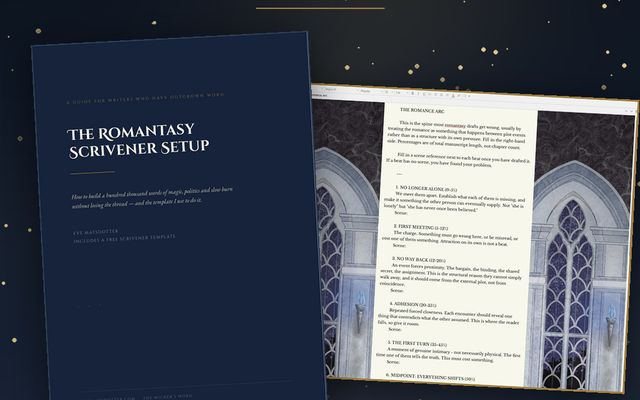
The whole thing is a free template, with a written guide, in the Scrivener setup I wish I'd had at 30,000 words.
You do not need Scrivener. A spreadsheet with one row per scene will show you the same thing. What you do need is some way to look at both plots at once.
How long should a romantasy novel be
Treat any number here as a general guideline, and check the source date.
The Manuscript Academy's 2026 word count guide, which draws on literary agent guidance, puts romantasy at 90,000 to 110,000 words and fantasy more broadly at 90,000 to 120,000. Those ranges describe what agents tend to want from manuscripts sent to them.
In draft one, word count is mostly a revision problem. The more useful number is the one that tells you where your beats are falling: if your midpoint arrives at 70 per cent, that is worth knowing now.
Frequently asked questions
How do you write romantasy if you have never written a novel?
Start with one character and the false belief she lives by, then decide what in your world keeps her from the person she will love. Pick five to ten scenes you are excited to write, hang them on a loose three-act frame, and draft.
What is the difference between romantasy and fantasy with a romance subplot?
In romantasy, the love story is central: remove it and the plot no longer works. In fantasy with a romance subplot, the main plot would still stand without the romance, though it would be poorer. What matters is knowing which you are writing, so you know which promise to keep first.
Do I need a romantasy beat sheet?
No, but you need some way to check that your romance arc and your external plot turn at the same moments. A beat sheet is the simplest tool for that, even for a pantser, used loosely as a set of fixed posts to write between.
How long should a romantasy novel be?
As a general guideline, The Manuscript Academy's 2026 agent guide gives 90,000 to 110,000 words for romantasy and 90,000 to 120,000 for fantasy. These are ranges for manuscripts submitted to agents. A first draft can run over or under and be fixed in revision.
Where I am, and where you are
I am 65,375 words into draft one of a planned 120,000, and that is as far as my authority goes.
So tell me: where are you in your draft, and which part is fighting you?
If you are writing your own, the Wickers Word has a fellow author option when you join the newsletter: the free Scrivener setup and my character sheets.
The Margins
Join the conversation
No notes in the margins yet. Be the first to leave one.
Keep reading
Related entries
 Writing
Free Scrivener Template: The Scrivener Setup I Wish I'd Had at 30,000 Words
I wrote the first thirty thousand words of my novel in a single document. One file, one scroll bar, and a growing certainty that something was wrong that I could not name. It was not the writing. It was that I had no way to see the shape of what I was making.
 Writing
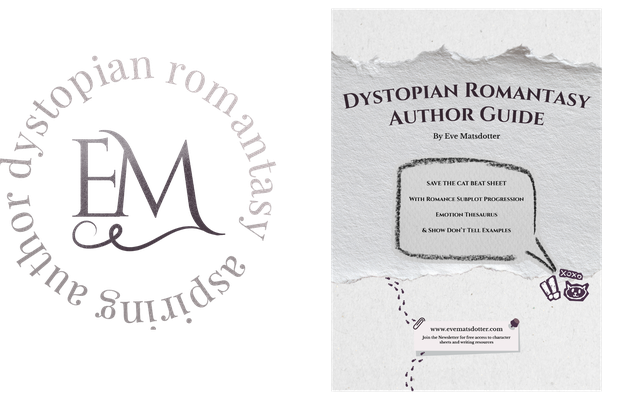
Save the Cat Beat Sheet for Dystopian Romantasy
This is a guide to structuring a dystopian romantasy novel with Blake Snyder's Save The Cat beat sheet. This guide has been specifically adapted to help you weave together two critical narrative threads: your high-stakes dystopian plot and your romance subplot.
 Romance Craft
How to Master Romance as a Subplot in Fantasy Novels
How to give your fantasy novel a romance subplot that deepens the story without taking over the main quest.